

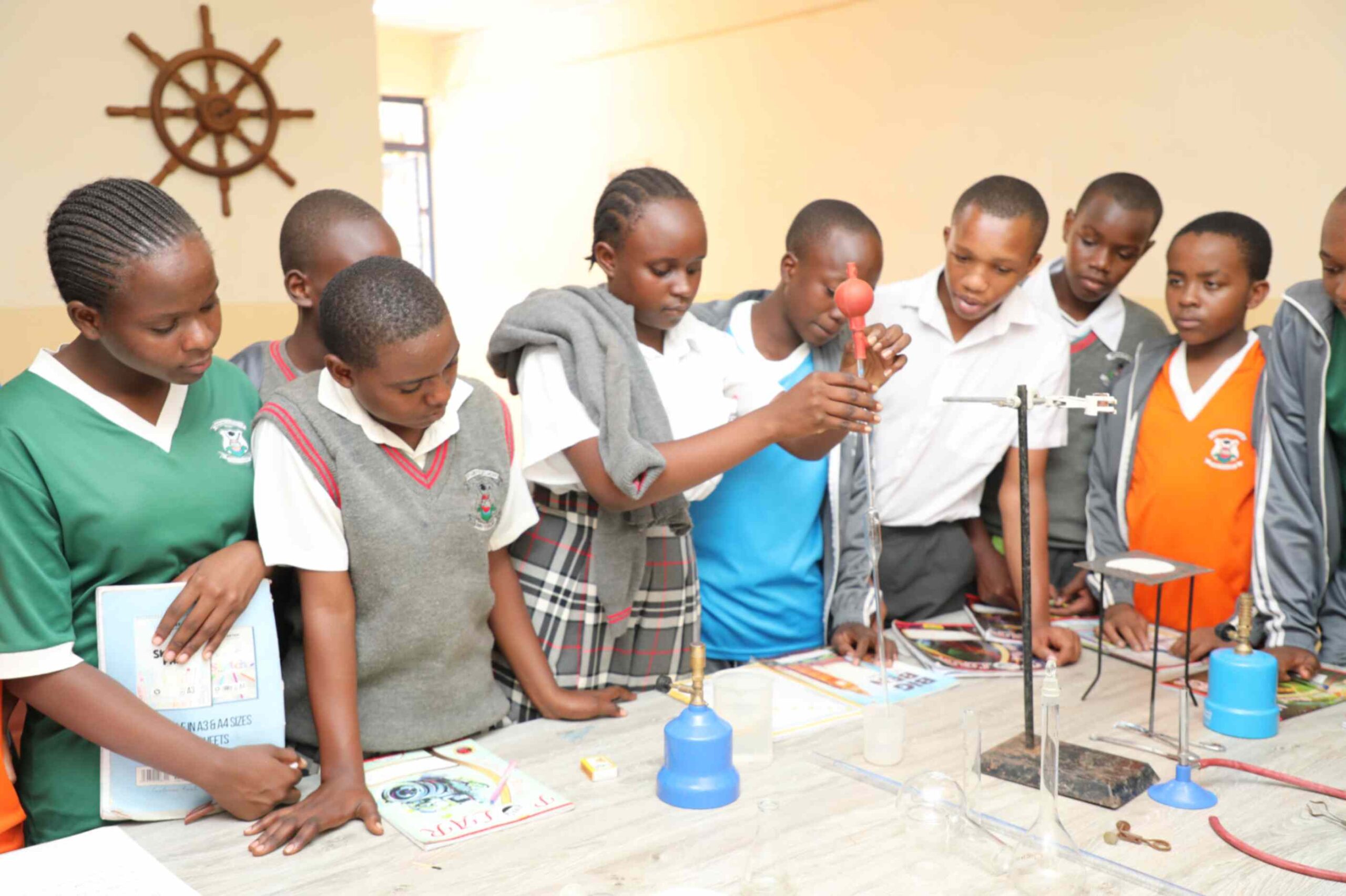

The Centre for Mathematics, Science and Technology Education in Africa (CEMASTEA) has launched renewed efforts to tackle negative attitudes towards mathematics and science among learners through practical STEM outreach programs in schools across the country.
The initiative, currently underway in Taita Taveta County, is targeting junior school learners with hands-on activities in science, mathematics and ICT aimed at building confidence and increasing uptake of STEM pathways under the Competency-Based Education (CBE).
Speaking during a STEM outreach session at Mwanyambo Junior School in Voi, Joseph Kuria, Coordinator, STEM mentorship and outreach at CEMASTEA said many learners shy away from STEM subjects because they perceive them as difficult.
“Maybe the perception for quite some time has been that mathematics is difficult and science is difficult, but our intention is to show learners that mathematics and science are not difficult,” Kuria said.
He noted that the program is part of broader efforts to prepare more learners for science-based careers that are essential to Kenya’s industrialization ambitions under Vision 2030.
“If more and more learners are taking up STEM subjects in the country, then we are preparing them for science-based courses at the university, and they will become the engine that steers our country towards industrialization,” he said.
The one-week-long outreach program is targeting learners from several schools in the county who rotate through different practical stations involving integrated science experiments, mathematical activities and pre-technical ICT lessons.
According to CEMASTEA officials, the practical approach allows learners to interact directly with equipment and scientific concepts instead of relying entirely on theory.
Kuria noted that although many junior schools still lack laboratories, practical science learning should not stop.
“The absence of laboratories should not mean experiments cannot be carried out. If schools can avail simple apparatus and equipment, teachers can still conduct experiments within the classroom,” he said.
Teachers who participated in the program said the workshops are helping address some of the major challenges facing STEM learning under CBE, including fear of technology and poor attitudes towards mathematics and science.
Christine Mutati, a teacher at Mwanyambo Junior School in Voi, said that learners became more open and enthusiastic after engaging in practical activities.
“The learners were able to interact with the equipment fully hands-on. It was not theoretical. What they were being told is what they were seeing,” she said.
Mutati added that many learners limit themselves when it comes to technology because they associate it mainly with entertainment rather than learning and innovation.
“They fear technology when it comes to the learning aspect. They think STEM is only for clever learners, but that is not the case,” Mutati said.
She urged education stakeholders to equip schools with learning materials and laboratory apparatus to strengthen implementation of STEM education in junior schools.
“We may not have physical laboratories in every school, but if schools are supported with learning and teaching aids, then learners can still benefit from practical lessons,” she said.
Learners who attended the program said the sessions had inspired them to pursue careers in STEM-related fields.
Grade Nine learner Wendy Kalega said the program completely changed her career ambitions, stating, “Before this program, I wanted to choose social sciences, but through CEMASTEA they have empowered me to choose STEM. I believe when I go to senior school, I will do well in STEM and become a professional dentist.”
Another learner, Reynold Mwambanga, said the program had inspired him to use science to solve real-life problems in his community.
“They have given me courage in STEM. I want to learn how physics can help solve problems like electricity shortages in our area,” he said.
According to CEMASTEA, the outreach program is also helping learners develop core competencies under CBE, including creativity, collaboration, critical thinking, self-efficacy and digital literacy.
The institution plans to expand the initiative to more counties as part of efforts to improve interest, performance and transition into STEM pathways among Kenyan learners.
So far, the program has reached eleven counties including Nairobi, Nakuru, Machakos, Nyeri, Kilifi, Garissa, Baringo, Kisumu, Kakamega, Uasin Gishu and Kajiado with Taita Taveta being the twelfth county.
