

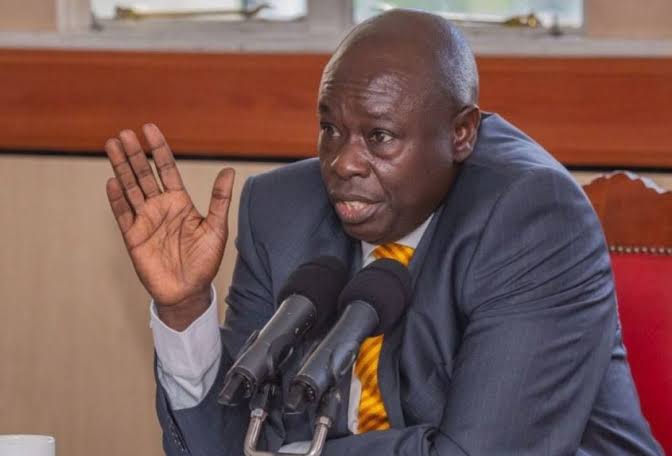

Deputy President Rigathi Gachagua has affirmed the government’s willingness to engage with macadamia processors and exporters, provided they offer better returns to farmers.
Speaking at the opening of the Agricultural Society of Kenya (ASK) Mombasa International Show on Thursday, Gachagua emphasized that discussions on minimum returns must occur before halting direct exports by farmers.
“Macadamia processors want us to stop farmers from exporting raw macadamia products. The Ruto Administration is open to this, but only if we agree on a minimum return that should not be less than what farmers are currently earning,” Gachagua said.
He added that the government, through Agriculture Cabinet Secretary Dr. Andrew Karanja, is ready to begin these discussions immediately.
The Deputy President highlighted that processors must offer farmers no less than the current pay of between KSh100 and KSh150 per kilogram.
“The farmer is king, regardless of the subsector. We will not hesitate to take short-term measures to protect farmers from exploitation,” he added.
Turning to the coffee sector, Gachagua noted that the government is working to comply with the European Union Deforestation Regulation (EUDR) by December 30, 2024.
This regulation requires exporters to prove that their products did not come from land deforested after December 2020.
Compliance is critical for Kenyan farmers to continue accessing the European market, which currently imports more than 55% of Kenya’s coffee.
“The EUDR supports ongoing reforms in the coffee subsector, particularly around traceability from the farm to the consumer’s cup,” Gachagua explained.
He added that the government is taking concrete steps, including mobilizing ministries, state departments, and agencies to form an inter-ministerial committee that will fast-track compliance with EU requirements.
In the 2022/2023 financial year, Kenya exported 48,000 metric tons of coffee, and the government aims to increase this to 60,000 metric tons by 2024/2025. The Deputy President stated that the goal is to further raise this figure to 102,000 metric tons by 2027, driven by ongoing reforms.
“To support these efforts, the government has distributed 49,000 seedlings to farmers in four counties. For the 2024/2025 financial year, we have allocated KSh3 billion to the Coffee Cherry Revolving Fund and an additional KSh2 billion for coffee debt waivers, addressing the cash flow challenges faced by our farmers,” the DP said.
He also reiterated that reforms in other key agricultural sectors, including tea, dairy, avocado, cotton, coconut, and macadamia, would continue to ensure farmers benefit financially.
Gachagua stressed the importance of technology in driving sustainable farming and economic growth, aligned with the Bottom-Up Economic Transformation Agenda.
“We must adopt climate-resilient technologies to overcome challenges in production. The innovations showcased at this exhibition present excellent opportunities for incubating and nurturing nascent ideas for the benefit of our farmers,” he remarked.
The Deputy President concluded by encouraging collaboration and continued efforts to boost Kenya’s agricultural sectors and improve farmers’ livelihoods.
