

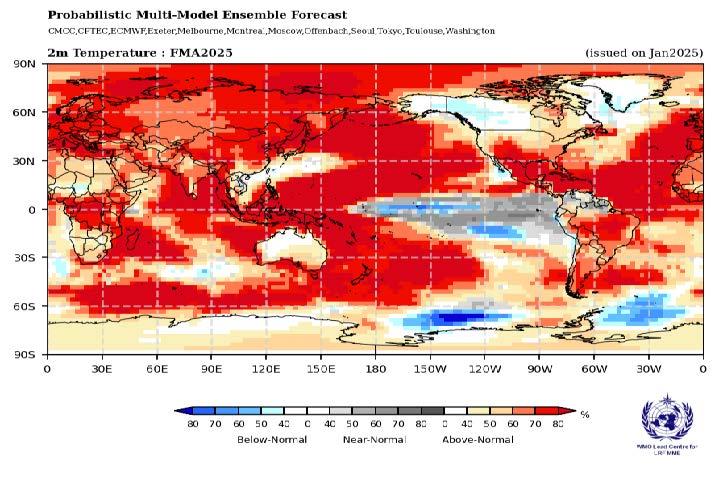

The long-term average temperature sits at around 1.3 degrees above the pre-industrial average and since the Paris Agreement has not yet been breached, it does highlight the urgency required towards efforts to minimize future warming.
Looking ahead to 2025, the Met Office outlook for global temperature is forecast to be between 1.29 and 1.53 degrees above the pre-industrial average, with a central estimate of around 1.41 degrees.
“2024 was the warmest year in record and the month of December 2024 was the 2nd warmest month” highlights Howard.
Speaking during the GHACOF 69th 2025 forum in Addis Ababa Ethiopia, World Meteorological Department representative Heidi Howard, says this is a suggestion that 2025 will be in the top three warmest years on record, falling just behind 2024 and 2023.
According to Howard, the reason that it may be slightly cooler than 2024 and 2023 is due to the transition away from El Nino conditions, which temporarily elevates global temperatures, while stressing that climate varies considerably over space and time.
Highlighting on drivers of seasonal variability, Rosana Amato also a representative from world meteorological department, cites that seasonal rainfall over East Africa differs from year to year in terms of the intensity and location, attributing that there are many factors which contribute to this variability.
“The largest and most predictable factor of this variability are ocean temperatures, where surface temperatures in the Pacific, for example, can directly influence the rain seasons in East Africa”. Amato adds
Additionally, Amato recognizes the Indian Ocean Dipole, or IOD as another indicator of seasonal rainfall variability in East Africa, stating that the IOD is currently in the neutral phase, and it’s expected to remain neutral throughout the March to May season.
