


Interview with Amos Chege,
PhD Researcher on Wildfires in Kenya,
King’s College London
1. Starting with your name, what is your interest in this project?
My name is Chege Amos, a PhD Research student, working on wildfires in Kenya, mainly in the protected and unprotected areas within the country.
My interest is documenting how wildfires have changed over the time within the protected and unprotected areas and then look at how we can incorporate local communities in the management of fires in these ecosystems.
This particular project has been funded by my university at King’s College to accelerate impact of community involvement in fire management frameworks in the country.
It builds from an initial workshop we had about decolonizing fire science where most of the community and Indigenous knowledge has been disrupted by colonization and people are not fully involved in fire management or in the creation of fire management frameworks.
So, we thought it would be wise to start at the local level, look at how local communities can be involved in the management and also utilize the Indigenous Knowledge that they have to manage fires which are now increasing in frequency and also in burnt areas.
- Can you please tell us about the pros of regulated or planned fires, since we’ve always been told only about the cons?
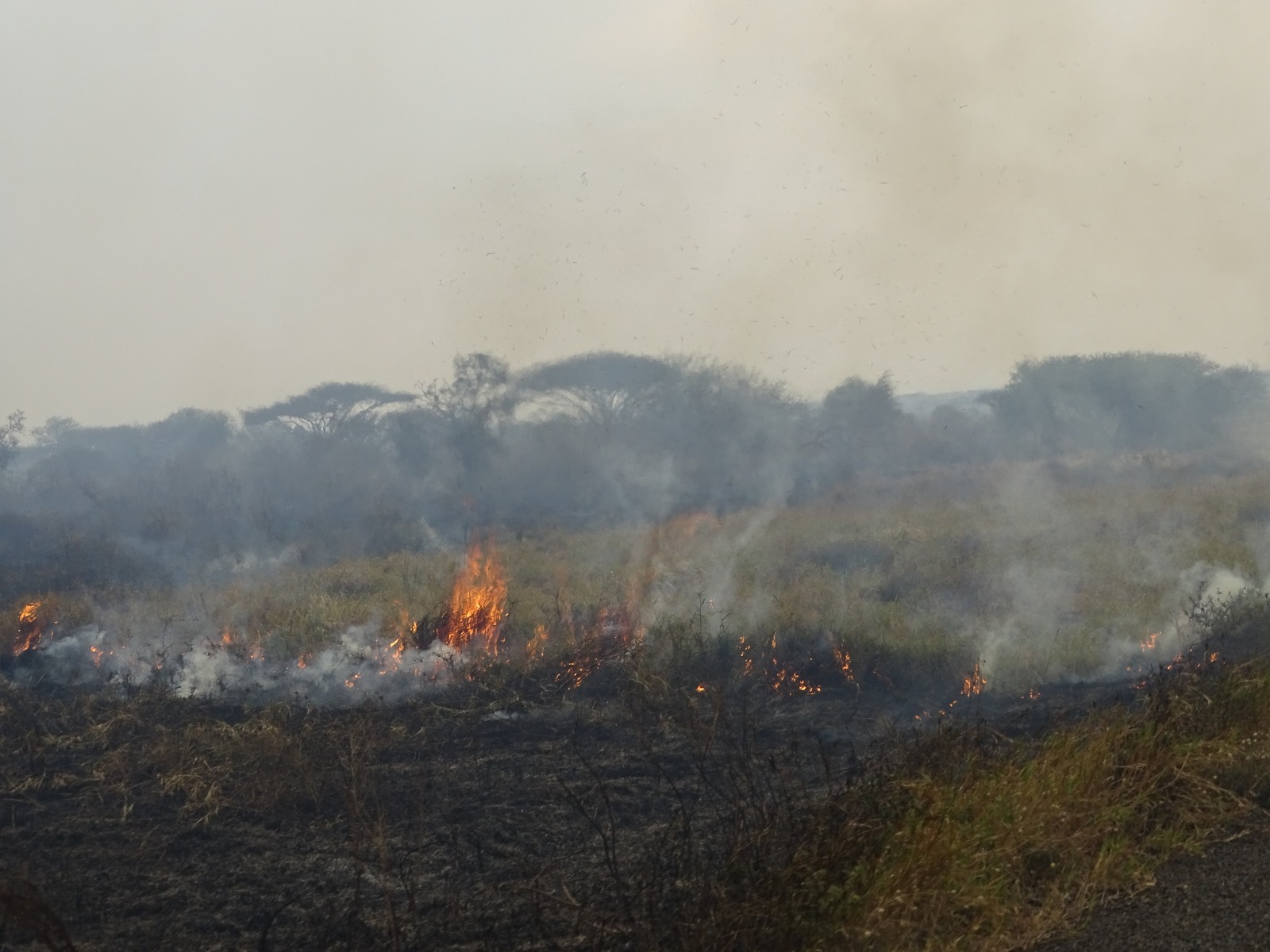
Fires are very Important in the Ecosystems and even from the social perspective, local communities have benefited so much from fires by managing pests within the areas of grazing, even clearing vegetation in their farms. But that has also the negative impact when it spreads to other areas.
But in the context of protected areas, fires are key in managing pests and diseases, controlling vegetation like reducing bushland to open up areas for further grazing. And also, fires are critical when it comes to shaping the ecosystems that we want to introduce new species, and it’s the easiest way to manage habitats.
Another key component about fires is that it also improves your soil quality. If you’re doing for example in agriculture and also in the range lands, it helps to get vegetation re-sprout again and you have got very fresh vegetation that the animals prefer.
And what it does when vegetation is disrupted, you have a better distribution of wildlife within the ecosystem because some of the grazers prefer to feed or to graze in open ecosystems. So, ecologically, fire is important and socially is also beneficial to the community.
- How has Kenya been managing its fires?
Most of the responses of Kenya has been reactive to fires, so after fire happens then we send the teams to manage fires. We do not have proactive management of fires and even the frameworks to manage fires are more oriented to fire suppression like if a fire happens then we have to suppress it within shortest time possible.
But historically, fire is important because it has shaped the ecosystem since millions of years ago and has continued to do that up to date. So, it’s not always the case of us responding to it, but how we can use it or rather react or plan ahead before the fire happens.
So, we have always been reactive rather than proactive and that has resorted to as incurring a lot of expenses in the management of fires. Poor planning for fire management because fire always get us unaware.
Our goal is to ensure that we are aware, and we can use fire to manage fires even in future when they happen, because you can use fire to manage fire. You can burn the low vegetation to protect the tall trees, for example when huge fires happen.
- Regarding the Fire Management Bill, what are some of the recommendations you’re proposing as an expert?
So, first of all, the bill only sets out penalties for people who set fire within the protected areas.
One of the things the bill does not put into account is fires in what the bill defines as conservation areas. It only provides for protected areas which are national parks, reserves and sanctuaries. But we also have other conservation areas like ranches, conservancies that are also important that are also affected by fires, and the bill does not include any regulation of fires in those areas, and they are as well affected by fires.
So, one of the things we are proposing is the inclusion of fire in the bill as maybe somebody sets fire in a ranch, would also be prosecuted with the same regulations within a National Park. So that is one thing.
The other thing is the bill proposes to have or rather, indicates there should be, you obtain a permit to burn an area, but it doesn’t provide where you’re supposed to get the permit from or who you’re supposed to apply the permit to control or to use fire within your area.
It also vaguely least prescribed burning and controlled burning, but doesn’t give the jurisdiction as to where you can apply fire, at what time, and the details of frequencies and what type of vegetation can be controlled with the fires or where specifically
So, these are some of the small things that we are proposing in the Act. e are also suggesting that we develop what we call integrated fire management plans and they should be embedded in the Act to enable quick fire management within the protected and unprotected areas or in general conservation areas.
- What are some details you would include in this Integrated Fire Management Plan, and is this a model that could be applied countrywide?
The framework of integrated fire management is defined as the most holistic and inclusive management plan, like we want to involve everybody in designing frameworks that we can use to manage fires within our ecosystems.
So, one of the key things that we are putting here is the Indigenous people knowledge and their practices in this concept because they have managed fires for many years even before colonization and they existed with this Ecosystem. So, one of the key things we are introducing is the Indigenous people knowledges and Cultural practices that can be adopted to manage fires within these ecosystems.
The other thing we are looking at s to have all the stakeholders, be it ranches, be it agriculture, be it adjacent local communities to the protected areas, be it the protected area management. We are bringing them together to define or rather to develop the plan that will work for everyone in the ecosystem.
So, first, the plan is holistic and secondly, it integrates both science that we are working on and Indigenous People Knowledge that they have, and they have used all throughout their years.
- Please share with us any success story of this program maybe in other parts of the world.
We have seen the integrated fire management frameworks implemented in different parts of the world and classical examples include the Australia where the cultural burning is used to manage climate change, that is, to manage the amount of carbon that is released by vegetation when wildfires occur.
That is a classic example that we can adopt here in areas where we are targeting carbon financing or carbon markets, which is the emerging sector in conservation. So, fires or prescribed fires or cultural fires or controlled fires can be used in climate change mitigation, like we have seen in those cases.
The other case would be even our neighbors here in Tanzania, they’re using fires in their protected areas to manage distribution of grazers and other species and even carnivores within the protected areas.
So we have so many examples globally, but Kenya has remained on the fire suppression policy and we do not practice it, and I think it’s the high time now we think about the benefits of fire and think about how we can implement fire sustainably in our ecosystems.
In the proposed integrated fire management plan, what happens is e introduce different methods to manage wildfires.
One of the key things that is more beneficial in the management of wildfires is fuel reduction which literally is the biomass that burns when fires occur.
To do that you find many people employ different mechanisms such as grazing. Others will do grass harvesting, for example wood collection. They reduce the amount of biomass that can burn during wildfires.
A very good example would be like the ranches we have here, the ranches that integrate both livestock and wildlife, burn less compared to the ranches that don’t practice livestock keeping.
The answer is simple because livestock reduce the biomass you have on your land making it to burn less when fires occur. And that helps of course, when it comes to climate change, specifically on the amount of carbon you release to the environment because there is less biomass to burn and that leads to less carbon to the environment.
- So, how do you think that the new vegetation that sprouts after burning is beneficial to climate change in relation to carbon emission?
So, what happens is when you burn and it rains and the grass re-sprouts again, the growing grass consumes more carbon during photosynthesis than the dry mass in any ecosystem. So, you find the new grass that is growing requires a lot of carbon dioxide helping human age the greenhouse gases like carbon dioxide from the ecosystem and which is what we refer as carbon reduction in the Atmosphere. So, when the grass re-sprouts, this grass coming up helps to manage our carbon, carbon in the ecosystem.
- Finally, in case there is something I have left out and you wish to share about the IFMP, could you please tell us.
For the integrated fire management, we have to do lot of studies to incorporate both the cultural burnings and the scientific advised burnings. So, therefore we need to understand a lot of climate valuables, vegetation behaviors to determine the seasonality when we can burn.
So, it is not casted on stones like we have to burn on January or February, but it’s a whole study that needs to be conducted to understand the weather patterns, the rainfall patterns and the temperatures and the right optimum temperatures or weather parameters to burn.
So, in most cases, most people practice what we call Early Burnings just a few months before the rainfall to reduce the fuel that can burn during the dry season and that helps to reduce the biomass.
So, if you burn at an early stage then you’re reducing the biomass such that even the dry season, if fire occurs, less is burnt.
