

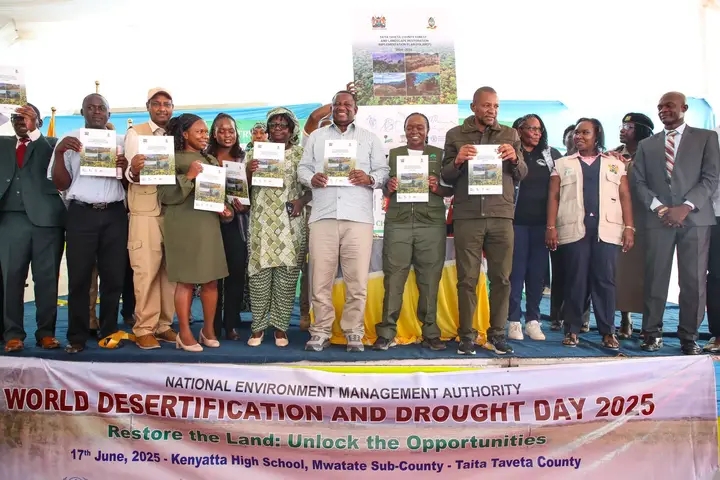

Kenya has turned the page on traditional desertification responses by embracing policy-driven, community-centered strategies as the new frontline in the fight against land degradation, a message which was emphasized during the national commemoration of World Desertification and Drought Day on Tuesday, in Mwatate, Taita Taveta County.
The event which was held at Kenyatta High School, brought together national and county leaders, environmental agencies, youth groups and women’s organizations, who emphasized a new approach that moves beyond symbolic tree planting and towards policies that make restoration economically viable.
Chief guest Cabinet Secretary for Youth Affairs, Creative Economy and Sports Salim Mvurya said that the country was shifting to what he termed “green patriotism,” where every ministry must contribute to sustainable forest restoration, not just during commemorative events but through their annual plans and operations.
“Our patriotism will be measured also by the efforts that we put in to restore our environment. It is not true that we can do a lot of agriculture without sustaining our environment and we succeed. So we need to coexist all our activities, weather, economic, Agri business, they have to coexist with restoration of our forest and that is why it is important to rally all Kenyans to work together with the Ministry of Environment and Climate Change and all other ministries to make sure that we plant trees,” said Mvurya.
He noted that with 23 of Kenya’s 47 counties falling under ASAL classification, the cost of inaction was far too high for both the environment and the economy.
Addressing the event on behalf of First Lady Mama Rachel Ruto, the CEO of Mama Doing Good, Mrs. Elizabeth Koskei, said land restoration should be a vehicle for empowering women and youth.
She revealed that 80 percent of Kenya’s land is ASAL and that nearly half the world’s population is already affected by land degradation. Citing the 2022 drought that left over 4.4 million Kenyans food-insecure, she emphasized that restoration must be about creating wealth, not just environmental aesthetics.
“Green jobs in land restoration across forestry and eco enterprises can uplift thousands, especially women and the young people that she really cares for the most, which strengthens our climate resilience. It protects peace. By securing natural resources, we reduce conflict and promote stability. We all need peace in our nation, and so restoring our land is a key factor in restoring peace among our communities. It strengthens our climate resilience. It protects peace,” said Koskei.
Koskei noted that the First Lady’s model of “one household, one school, one village” was already yielding results, where women are running tree nurseries, practicing climate-smart agriculture and engaging in fruit value chains for crops like mangoes, oranges, and avocados.
“Our Green Tree Commodity initiative is helping women turn trees into income. From oranges to avocados to mangoes to name but a few. We have seen women LED tree nurseries, practice climate smart agriculture and become stewards of environmental change. When we empower women to restore the land, we unlock opportunities for the entire community,” she added.
She called on national and county governments to invest in supporting such community-led interventions, which she said were key to sustainable land use and resilience. “Let’s impress innovation. Let’s include indigenous knowledge and green technologies together to restore our environment, empower communities, especially women and youth, to lead local solutions. And above all, let’s collaborate urgently, for this work is too important for one to stand alone. Ministries alone, government agencies alone will not make it. But we need everyone in,” said Koskei.
NEMA Director General Mamo B. Mamo said the country must now embed restoration science into national plans, adding that land degradation has moved from being a rural issue to a national development concern.
He pointed out that 40 percent of global land is degraded and Africa has already lost over 65 percent of its productive land.
In Kenya, 38 percent of the population lives in ASAL areas and faces the risk of drought, famine, forced migration and biodiversity loss.
He noted that NEMA had adopted a comprehensive strategy that includes enforcing environmental impact assessment (EIA) regulations, revising outdated wetlands laws, integrating land degradation neutrality (LDN) into national policy, and monitoring tree planting through the “Jaza Miti” mobile application.
Mamo announced that Kenya had designated Mwangea Hill in Taita Taveta as a demonstration site for achieving LDN, saying the initiative would showcase how science, governance and community participation can restore ecosystems while generating jobs and boosting household incomes.
“Here at Taita Taveta County, the Authority is exploring on forging partnership with the County Government and other stakeholders for initiating a Land Degradation Neutrality Demonstration Pilot at Mwangea Hill. I call stakeholders to join NEMA in implementing this noble project so that we can be the learning example for Africa on Land Degradation Neutrality,” said Mamo.
The Cabinet Secretary for Environment, Climate Change and Forestry, Dr. Debora Barasa, said the government would continue implementing the 15 billion Tree Growing Programme while reviewing policies to increase protection of sensitive ecosystems.
She confirmed that Kenya was aligning itself with the global target of restoring one billion hectares of degraded land by 2030, as outlined in the UN Convention to Combat Desertification (UNCCD), and would support the African Group’s push for a legally binding drought protocol to be adopted at COP17 in Mongolia in 2026.
“I would like to reiterate that my Ministry in collaboration with stakeholders will continue to provide strategic leadership in developing comprehensive further strategies for advancing Land Degradation Neutrality which is a critical vehicle for restoring degraded landscapes,” said Barasa adding that, “We will continue to also follow closely the emerging UNCCD decision aligned to desertification, land degradation and drought control and accordingly domesticate such decisions once adopted by the conference of Parties.”
Taita Taveta Governor Andrew Mwadime urged the national government to support counties in ASAL zones with climate-resilient seedlings and inclusion in national resilience programs.
He said residents of Taita Taveta are hardworking but need support in terms of irrigation infrastructure and reforestation technologies tailored to dryland environments.
County Commissioner Josephine Onunga called for strict regulation of sand harvesting and charcoal burning, citing their role in land degradation. She added that enforcement of land use laws must go hand in hand with restoration projects. Similarly, Mwatate MCA Joseph Kennedy challenged those involved in tree planting around water catchment areas to take up guardianship roles to protect the sources.
On her part, County Woman Representative Lydia Haika urged the Ministry of Water and the National Government to fast-track the Mzima II water project and scale up community sand dams to enhance water access in drought-prone areas. She called for budgetary prioritization of land and water conservation programs.
The Cabinet Secretary for ASALs and Regional Development Beatrice Askul said her ministry would focus on building local resilience through the promotion of sand dams, rock catchments, drought-resistant crops and improved governance of community land. She said ASAL development could only succeed if the communities were meaningfully involved and supported to innovate solutions based on their unique contexts.
NEMA Board Chairman Emilio Mugo said the agency had made it mandatory for all development projects to submit restoration plans before getting environmental approvals. He called for the use of nature-based solutions and carbon markets to finance large-scale restoration. Mugo added that scientific evidence would now guide all national restoration programs.
Mamo further revealed that NEMA is currently revising the 2003 Environmental Impact Assessment and Audit Regulations, as well as the 2009 Wetlands, Riverbanks, Lakeshores and Seashores Management Regulations. Once passed, the reforms will impose stricter restoration obligations on developers and strengthen protections for ecologically sensitive areas.
He reiterated that restoration efforts must now be economically linked to job creation and community resilience. “We must shift from talking about hectares restored to households empowered,” he said.
The event, held under the theme “Restore Land, Unlock Opportunities,” came at a time when Kenya, like many other nations, is grappling with the dual threat of ecological decline and climate-induced disasters. Leaders at the event agreed that restoration must go beyond ceremonies and be built into local development plans, school curricula, women-led enterprises and digital tracking systems that can hold everyone accountable.
Participants called for increased funding for local projects, integration of restoration with national climate adaptation strategies and scaling of successful community models such as Mwangea across all 23 ASAL counties.
