

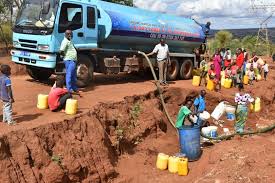

As climate change continues to intensify drought conditions across Kenya, Taita Taveta residents are staring at high rate of water rationing in the coming days after water levels in most of boreholes and springs reduced gradually.
According to CECM Water, Sanitation, Environment, Climate Change, and Natural Resources, Mr. Grantone Mwandawiro climate change has negatively affected water catchments, springs and dams in Taita Taveta County despite the increasing water demand in Voi, Wundanyi, Mwatate and Taveta towns which is currently at approximately 30 million liters per day in towns due to the rising population while only 16 million liters of water is supplied in towns.
“We have been able to supply 16Million liters of water to taita taveta residents because most of our infrastructures are very old and cannot sustain high water pressure, but we are currently replacing all old metallic pipes to reduce non-revenue water and theft so that we increase our water coverage both in urban and rural areas” said CECM Water Mr. Grantone.
The CECM water claimed that over 75% of water supplied in Taita Taveta by TAVEVO come from Mzima springs and Njoro while other water sources produce the remaining percentage for the supply which according to Grantone is not sufficient for the growing population and demand for domestic and commercial purposes. He called for urgent investments in water infrastructure, environmental conservation, and community awareness to secure the limited water infrastructures.
“Taita Taveta county may not be water sufficient until joint efforts by the government, private sector and community is protecting the water catchment areas, reduce cutting down of trees and bush clearing so that rainwater can be harvested hence increasing water recharge. We have witnessed cases of wildfires which have negatively affected the underground water levels in rivers and boreholes which risk increase conflict between communities hence urgent joint action must be taken to save the situation” added Grantone.
One of water projects already experiencing harsh weather conditions is Mwakimori borehole which initially produced 20,000 cube per hour but after a period it gradually reduced to 8,500cube per hour and very recent testing done by water engineers from Tavevo found out the borehole is currently producing only 1 cubic per hour.
Despite being home to major natural sprazings such as Mzima and Njoro Kubwa, many residents in Taita Taveta County continue to struggle with water shortages. The county, which supplies water to several coastal counties, still faces challenges of water rationing, drought, deforestation, forest fires, and illegal water connections that have affected consistent supply to households.
According to Mr. Grantone Mwandawiro, CECM Water, Sanitation, Environment, Climate Change, and Natural Resources Taita Taveta County, only about 62% of residents currently have access to reliable water supply, leaving thousands vulnerable to recurring shortages.
Water theft is also identified as a major setback, with the CECM estimating that nearly 42% of non-revenue water is lost through illegal connections, leakages, and damaged infrastructure. These losses have affected revenue collection and slowed down projects meant to improve water access across the county.
“Non-revenue water is a challenge. It was at 50% but we have managed to lower it to about 42%. We are doing a project that will mitigate the problem by changing the old pipelines to new and new connections. We are hoping that by the time the project is over we will have managed to lower the non-revenue water percentage by 10%,” said Mr. Granton.
Moreover, several interventions are underway to address the crisis. Among the major projects expected to transform water supply is the Njoro Kubwa water project, which aims to increase water production and improve distribution in the county. The county is also banking on the long-awaited Mzima II water project, expected to improve supply not only in Taita Taveta but also across the coastal region.
To improve sustainability, Mr Grantone proposed solutions such as water harvesting, water conservation, tree planting, and public-private partnerships to support infrastructure development. Environmental conservation has been emphasized to protect water catchment areas and ensure future water security.
Mr. Grantone has noted that completion of ongoing projects such as the clean energy projects will significantly reduce the burden on bills from fuel and electricity and on residents.
“By the day, electricity bill is on the rise and TAVEVO is suffering from losses. We have been insisting on having our own tariff for the water companies so that our customers can access water at an affordable cost. In 2023-2024 TAVEVO paid Ksh.94 million on electricity alone and so we decided to shift to a hybrid system. So far, we have completed 10 projects, and we have 19 more underway. The system has indeed helped a lot because the cost came down from Ksh.94 million to Ksh.75 million in 2024-2025 and we are hoping that it reduces more,” said Mr. Granton.
In conclusion, while Taita Taveta County remains a critical water source for the coastal region, persistent challenges such as drought, environmental degradation, illegal water connections, and aging infrastructure continue to hinder reliable water access for many residents.
However, awaited projects like the Njoro Kubwa and Mzima II water projects, alongside investments in clean energy and water infrastructure, offer hope for improved supply and sustainability. As climate change and population growth place increasing pressure on available resources, collective efforts in water conservation, environmental protection, and community awareness will be essential in securing the county’s water future and ensuring that more residents gain access to safe and reliable water services.
According to forecast by IGAD Climate Prediction & Applications Centre (ICPAC) report indicated that there is a very high likelihood of below-normal rainfall over the central, north-eastern and north-western Ethiopia, Southern Sudan, and northern Uganda, where probabilities exceed 60%, with peaks reaching up to 80% in north-eastern Ethiopia.
In contrast, isolated areas in northern Sudan, South-eastern Ethiopia, and southern and northern Somalia are expected to receive enhanced rainfall while areas like northern Sudan, southern coastal Somalia and Kenya are expected to receive near-normal rainfall.
High temperatures of above-normal across most parts of the region with highest probability of warmer-than-normal conditions will be witnessed over the northern Sudan, most parts of South Sudan, and Ethiopia.
The experts further stated that some countries like Kenya and Sudan are set to experience high cases of typhoid, poor air quality which will lead to increased cases of respiratory diseases in the region due to the projected weather conditions. Other health complications attributed to the June-September (JJAS) 2026 season are heat stress in town and remote areas, increased cases of mental health due to high temperature.
