

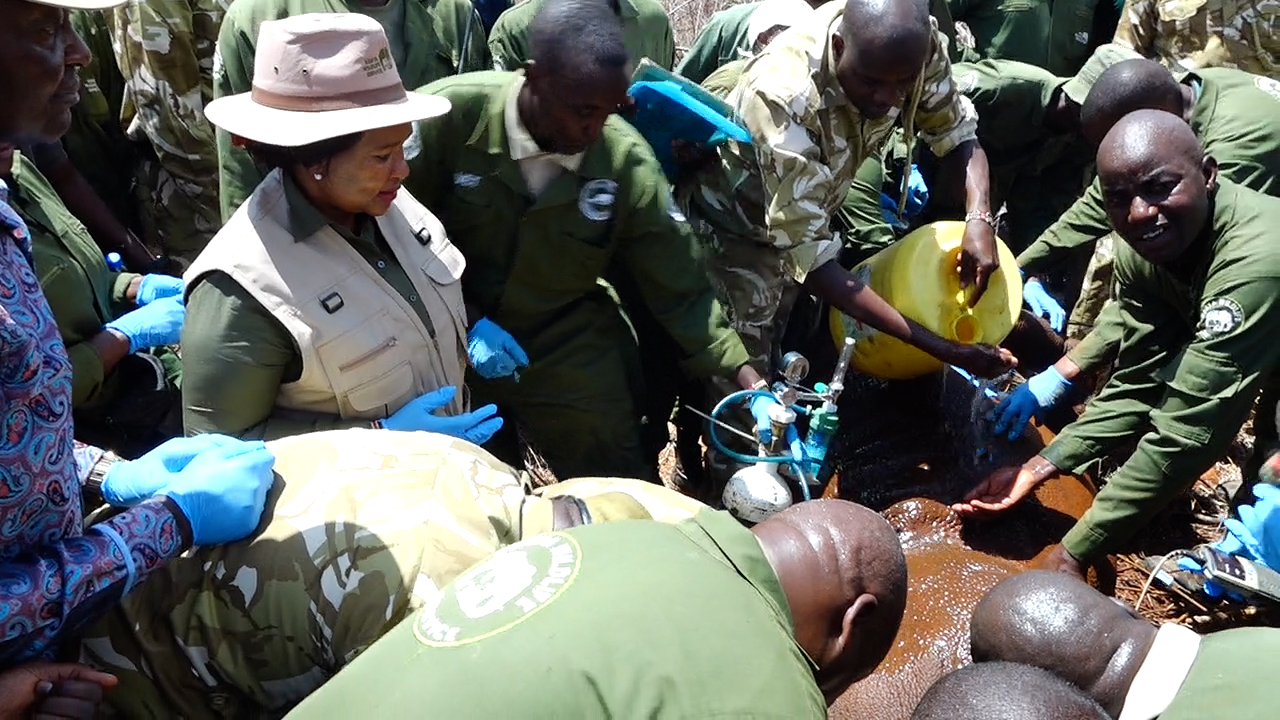

The Kenyan government on Wednesday launched a state-of-the-art tracking system for black rhinos at the Ngulia Rhino Sanctuary in Tsavo West National Park.
This initiative aims to boost conservation efforts for one of the world’s most critically endangered species.
Leading the launch, Tourism and Wildlife Cabinet Secretary Rebecca Miano introduced this innovative approach, which combines ear-notching and real-time surveillance, to deter poaching and safeguard the rhino population.
The Kenya Wildlife Service (KWS) manages this project, using cutting-edge devices to monitor the health and movements of 178 black rhinos within Tsavo West’s conservation area.
Ngulia Wildlife Sanctuary is home to 90% of the remaining southern black rhinos globally.
Miano highlighted Kenya’s critical role in wildlife conservation, noting that the sanctuary has successfully increased its rhino population from just three to over 100 in four decades.
She expressed pride in Kenya’s conservation achievements, calling for national unity in protecting this natural heritage.
“Kenya being a custodian of 90% of southern black rhinos, 90% of those in the world are found in Kenya. And so we need Kenyans to know what heritage we hold and that conservation is an initiative that no one should be left behind and Kenyans can only participate if we give them the information and we show them what we are doing,” said the CS.
The tracking devices, including VHF transmitters and ear notches, enable KWS to monitor each rhino’s location hourly, providing valuable data to enhance anti-poaching operations and improve care for these animals.
KWS Director General Prof. Erastus Kanga explained the new technology’s impact, stating that a long-range network device would provide a full year’s tracking data, supporting both aerial and ground monitoring.
“We have tagged the animals in three ways. We have done earmarks and we put in a number there. The number was I think 130. And we have also put in a transmitter that is a VHF that when you are out flying you can go to locate where the animal is. The third one is a long range network device that is able to give us signals every one hour of where the animal is and the wellbeing of the animal and we’re able to collect a lot of other information using those devices,” Prof. Kanga explained.
This high-tech tracking initiative costs approximately Ksh. 4 million, funded by the government with support from KWS partners. During the launch, a rhino was named “CS Madam Miano” to honor the Cabinet Secretary, who adopted it as a symbol of Kenya’s dedication to wildlife protection.
The government also encourages both public and private entities to adopt rhinos, advancing the “Tuza Mali Yako” campaign to foster broader support for wildlife conservation.
“Our clarion call is that we are asking our executives both in private and in public to come in and adopt the very many other animals, especially the critically endangered ones that we are conserving so that we can all learn together and conserve our heritage,” Kanga stated, urging Kenyans to join KWS in the ‘Tuza Mali Yako’ initiative adding that the heritage that the government has given to Kenya Wildlife Service is the people’s heritage and that KWS is there to protect and conserve.
Addressing human-wildlife conflicts, Miano outlined measures to compensate communities affected by wildlife interactions. She emphasized that the government values the efforts of communities coexisting with wildlife but acknowledges the challenges they face.
In a recent event in Rumuruti, President William Ruto relaunched the compensation program, highlighting the government’s commitment to address community concerns.
The ministry also established County Wildlife Compensation Committees (CWCCs) to review and process compensation claims.
“Compensation is crucial for resolving human wildlife conflicts. So after launching the CWCCs, we are now putting effort to look for funds and resources so that we can catch up with the backlog,” said the CS.
Miano emphasized that these conservation efforts align with Kenya’s broader strategy to expand its wildlife economy, a cornerstone of the nation’s tourism sector.
The Kenya Kwanza administration’s vision includes increasing wildlife populations and ensuring the sustainability of Kenya’s unique species, which are central to the country’s cultural and economic identity.
“Looking ahead, we are dedicated to compensating communities swiftly and ensuring conservation benefits are sustainable for future generations,” Miano added.
